What 4D looks like ?

For everything that's not in any way related to PureBasic. General chat etc...
threedslider
Enthusiast
Enthusiast
Posts: 562
Joined: Sat Feb 12, 2022 7:15 pm

Re: What 4D looks like ?

Post by threedslider »

@STARGÅTE :

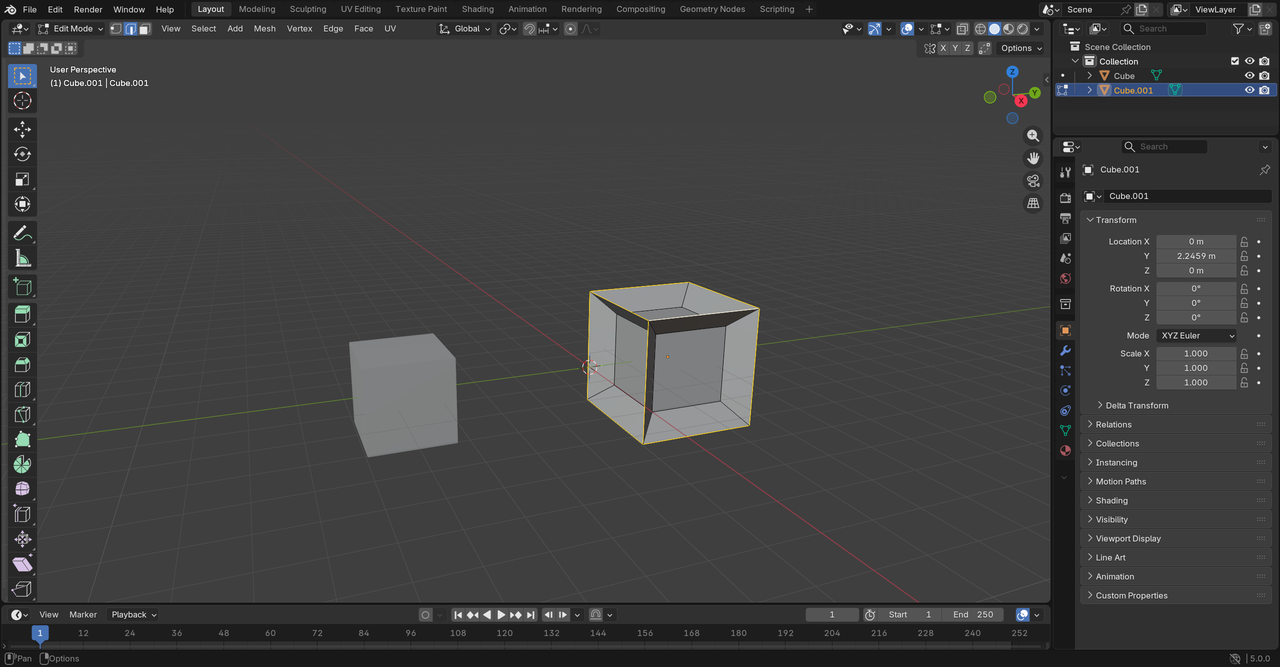
You are right, extrusion in Z is not right everything... Thus 3D is already cube and i only extrude the time (line as 1D) over cube, it makes more that this :
Image

It looks like more to terrasect !
User avatar
STARGÅTE
Addict
Addict
Posts: 2286
Joined: Thu Jan 10, 2008 1:30 pm
Location: Germany, Glienicke
Contact:

Re: What 4D looks like ?

Post by STARGÅTE »

Dear threedslider,

you mix up different topic: dimension itself, dimension of objects in different dimensions, and the projection (image) of n-dimensional objects into a view.

Dimension itself:
A 4-dimensional (4D) space is a space were you have 4 linearly independent axis.
The easiest definition would be (x,y,z,w) with the base (1,0,0,0), (0,1,0,0), (0,0,1,0) and (0,0,0,1).
Such space is also euclidean, because euclidean is not limited to 3D [see Euclidean space].
They have normal distances like sqrt(x^2+y^2+z^2+w^2) etc.
Only in such a 4D space you can add objects with 0, 1, 2, 3 or 4 dimensions.

Dimension of objects:
An n-dimensional object is an object in n or more dimension with an expansion in n directions. You can not "create" 4D in a program with just three dimensions, what ever you try. You can only create a projection (see below).

The projection of objects:
The projection of a 4D space into a 2D space needs a 2×4-matrix, because you want to transform (x,y,z,w) to (x',y'). Such matrix could be very easy, and you did this in basic school already. You draw x and y into x' and y' of your view, and make z diagonal. The same can be done for the 4th dimension and so on. But all are just projections. You can not imaging a four dimensional object itself, only the projection in 2D or 3D.

In summary:
The tesseract (your last picture) is probably the most common way to project the 4D cube into the 3D world and render it on the 2D screen.
PB 6.01 ― Win 10, 21H2 ― Ryzen 9 3900X, 32 GB ― NVIDIA GeForce RTX 3080 ― Vivaldi 6.0 ― www.unionbytes.de
Lizard - Script language for symbolic calculations and moreTypeface - Sprite-based font include/module
User avatar
minimy
Addict
Addict
Posts: 845
Joined: Mon Jul 08, 2013 8:43 pm
Location: off world

Re: What 4D looks like ?

Post by minimy »

STARGÅTE wrote: Sat Jan 03, 2026 5:48 pm
In summary:
The tesseract (your last picture) is probably the most common way to project the 4D cube into the 3D world and render it on the 2D screen.
@STARGÅTE. Fully agree with you. The rest is into the field of 'metaphysic' i think.

@Threeslider. But what is the point of this?, i think the point of 4D in our day by day is time/space, no more, With design, simulations, etc.

I think that only if you are a theoretical physicist can you find some use for it (excuses to support theories that cannot be proven :mrgreen: ). But in that case 'Sheldon Cooper' surely has the answer. :lol:

For visual effects is nice too. Imagine a Discoteca with big effects in the walls with hipercubes and tesseracts running with first cup for free and happy hour too! :lol:
If translation=Error: reply="Sorry, Im Spanish": Endif
threedslider
Enthusiast
Enthusiast
Posts: 562
Joined: Sat Feb 12, 2022 7:15 pm

Re: What 4D looks like ?

Post by threedslider »

Yeah maybe :shock: :mrgreen:

But my original 4D, the extrusion is a face outside pointed but if i resize in inside the cube we have the same a terrasect ! Got it ?

Your base in 4D is interesting (1,0,0,0) (0,1,0,0) (0,0,1,0) (0,0,0,1) but dunno if it works like that because of 4th axis is a strange as extra dimension... :shock:

That is work for 4D matrix ??

the w axis needs to give me more information :lol:

If we agreed that we see the terrasect a cube inside the cube, something it looks like a cycles of in/out, a cube is a 3D space however a 4D the representation is two cube which the transformation is merged by time, it means to 3D space inside to 3D space...

In summary:
The tesseract (your last picture) is probably the most common way to project the 4D cube into the 3D world and render it on the 2D screen.

Imagine to 4D as double 3D space inside each other and ... to render in 2D is quite impossible for me !!! :shock: because the time extra dimension is a "ghost"

I think for 4D more like to this mocking by Jean Pierre Petit : https://unilater.com/fr/ ... See you by yourself :mrgreen:
threedslider
Enthusiast
Enthusiast
Posts: 562
Joined: Sat Feb 12, 2022 7:15 pm

Re: What 4D looks like ?

Post by threedslider »

minimy wrote: Sat Jan 03, 2026 6:34 pm
STARGÅTE wrote: Sat Jan 03, 2026 5:48 pm
In summary:
The tesseract (your last picture) is probably the most common way to project the 4D cube into the 3D world and render it on the 2D screen.
@STARGÅTE. Fully agree with you. The rest is into the field of 'metaphysic' i think.

@Threeslider. But what is the point of this?, i think the point of 4D in our day by day is time/space, no more, With design, simulations, etc.

I think that only if you are a theoretical physicist can you find some use for it (excuses to support theories that cannot be proven :mrgreen: ). But in that case 'Sheldon Cooper' surely has the answer. :lol:

For visual effects is nice too. Imagine a Discoteca with big effects in the walls with hipercubes and tesseracts running with first cup for free and happy hour too! :lol:
I proved my original 4D is more like terrasect, to resize it is same in or outside, try yourself in Blender :)

As i give you a link from Jean Pierre Petit, I think the 4D is more like something this, something the 4D is a in/out that reverse in direction :shock:
User avatar
IceSoft
Addict
Addict
Posts: 1708
Joined: Thu Jun 24, 2004 8:51 am
Location: Germany

Re: What 4D looks like ?

Post by IceSoft »

Real 4D on a 2D view:
but the rotten apple have to be the same place as the left apple currently its 2 different apples.
Image
Belive! C++ version of Puzzle of Mystralia
Bug Planet
<Wrapper>4PB, PB<game>, =QONK=, PetriDish, Movie2Image, PictureManager,...
threedslider
Enthusiast
Enthusiast
Posts: 562
Joined: Sat Feb 12, 2022 7:15 pm

Re: What 4D looks like ?

Post by threedslider »

benubi
Enthusiast
Enthusiast
Posts: 241
Joined: Tue Mar 29, 2005 4:01 pm

Re: What 4D looks like ?

Post by benubi »

How about moving in 5D is to move between different planes of reality; when you do a 5D rotation (or something of that sort), the James Bond girl has no more braces in our perspective of reality. But somewhere on a parallel plane the opposite is true: they see a girl with braces where there wasn't one before. Could that be how the 'Mandela effect' works mechanically? Perhaps the trick works with simple 3D/4D analogically to lemon ink and other "magic" inks but that would have to be done already during production. Some people claim that there are much deeper changes than visuals and word spellings, like entire continents missing on a map - but they are extremely rare compared to the bond girl and jungle book "witnesses".
:D
threedslider
Enthusiast
Enthusiast
Posts: 562
Joined: Sat Feb 12, 2022 7:15 pm

Re: What 4D looks like ?

Post by threedslider »

Well for 5D ... It is more complicate than this because for example for 4D there is 3D + 1D(time) it is same for 3d except it change with time in all direction, now for 5D there is 3D + 2D (time + location) ! So what does it mean ?? I think it is same as 4D but adding more to location with time... difficult to explain it ? :shock:

So nobody has a topology for 5D from now :shock: :mrgreen:
threedslider
Enthusiast
Enthusiast
Posts: 562
Joined: Sat Feb 12, 2022 7:15 pm

Re: What 4D looks like ?

Post by threedslider »

For 6D well you know is 3D + 3D it is one of the most profound from reality :shock:

And 7D, another a complete of change for reality !!

And so on...
threedslider
Enthusiast
Enthusiast
Posts: 562
Joined: Sat Feb 12, 2022 7:15 pm

Re: What 4D looks like ?

Post by threedslider »

minimy wrote: Sat Jan 03, 2026 12:42 pm 4D is relative to time and space.
Like this:

Image
Ok but for me 4D is multiverse after you have showed this picture... A box (T=0) and another box (T=1) and then another (T=2) and so on... that shows the time, the universe is separated by other universe... What do you think of that ?
Olli
Addict
Addict
Posts: 1281
Joined: Wed May 27, 2020 12:26 pm

Re: What 4D looks like ?

Post by Olli »

I did not understand anything here.

4D is a tool. More generally "xD" ( or "nD") is a tool.

Just structure the several details of the friends :

Code: Select all

Global Dim LimitedSpace4D.D(15, 15, 15, 15)
This below is a 4D-memory, as I read before, and I thank the author.

But, after, it just is a "Global Dim" which allocates a 4D space.
This is not a set of procedures.

If you want to master everything about the 4D, do not think your life has this time to know everything about the 4D.

Just imagine all the characteristics of 1D (a list of floating point numbers)

Code: Select all

Global Dim LimitedSpace1D.D(65535)
What can we see ? A list which have a begin and an end.
Physically, this means a field : we can store in memory 65536 real values and we can consider that the "distance" between two contiguous values, is the same.

I used the number 65535 (plus the index #0) : it just is to show you that we have the fortune to have a good hardware which can help you, in a very strongly regular way, by indexing 16*16*16*16 values : the LimitedSpace4D(15, 15, 15, 15).

But let's forget a so big number : let's reduce to 4 values.GLOBAL DIM veryLimitedSpace1D.d(3) and let's imagine we need to manage an unlimited space.

Actually, we use 4 real values, as 4 buildings, each one behind the other one :Global Dim buildingHeight.D(3).

But, let's imagine, we must calculate the shadows in the floor between building whatever the randomized distance between themselves.

No problem !

Code: Select all

Global Dim BuildingHeight.D(3)
Global Dim BuildingDistance.D(3)
Now... We decide that the planet is not flat anymore !
The planet is now round and very small. It is such small that, behind the 4th building (#3), you find again the first building (#0).

Then, the "BuildingDistance" becomes an angular value.

Code: Select all

Global Dim BuildingHeight.D(3) ; same name
Global Dim BuildingLatitude.D(3) ; name has changed
Now, let's imagine that we live in one of these buildings. And let's imagine we want to create our single planetarium in one room of this building, a planetarium representing this beautiful small planet and its 4 buildings.

Code: Select all

Global Dim BuildingHeight.D(3)
Global Dim BuildingLatitude.D(3)
Global Dim PlanetariumBuildingHeight.D(3)
Global Dim PlanetariumBuildingLatitude.D(3)
Then, now, let's imagine that all these buildings, as if they have been built with any chewing-gums, we lay all them in the perpendicular direction, to the alignment of these buildings.

This means then, that the building height values become any angular values.

Code: Select all

Global Dim BuildingLongitude.D(3)
Global Dim BuildingLatitude.D(3)
Global Dim PlanetariumBuildingLongitude.D(3)
Global Dim PlanetariumBuildingLatitude.D(3)
And, to continue, we destroy the 3 other buildings, because, there is nobody inside them, they contains asbest in their structure, etc...Let's destroy them, them, and their 3 small copies in the planetarium...

Code: Select all

Global Dim BuildingLongitude.D(0)
Global Dim BuildingLatitude.D(0)
Global Dim PlanetariumBuildingLongitude.D(0)
Global Dim PlanetariumBuildingLatitude.D(0)
Let's simplify this:

Code: Select all

Global Dim a1.D(0)
Global Dim a2.D(0)
Global Dim a3.D(0)
Global Dim a4.D(0)
We could say here, that we have a 4D number.

And, let's imagine we observe a second same planet, and we want to know all the interactions between the two planets :

Code: Select all

Global Dim a.D(4, 4)

a(0, 1) = a1
a(0, 2) = a2
a(0, 3) = a3
a(0, 4) = a4

a(1, 0) = b1
a[2, 0) = b2
a(3, 0) = b3
a(4, 0) = b4
Here, even if we have a 16D object, even if, considering the zeroed indices, we have a 25D object, we cannot talk about a 16D object, nor a 25D object. We can just say we want all the interactions between the two 4D objects.

This results in 4 * 4 interactions, which are not independant neither respective : these 16 interactions are just distributive.

Code: Select all

For jj = 1 To 4
 For ii = 1 To 4
  CallFunctionFast(*operation, @a(jj, ii), a(0, ii), a(jj, 0) )
 Next
Next
... where *operation can point to a set of 4D procedures.
threedslider
Enthusiast
Enthusiast
Posts: 562
Joined: Sat Feb 12, 2022 7:15 pm

Re: What 4D looks like ?

Post by threedslider »

Thanks for your explanation and you try it out on what 4D mean.

Honestly in your explanation I didn't quite understand it so here for 4D we talk the dimension and what it looks like in reality as shape something with geometry.

The four number as Stargate suggests it are x, y, z and w, they are coordinate in space and time.

Voilà, I hope that help you with 4D :D
threedslider
Enthusiast
Enthusiast
Posts: 562
Joined: Sat Feb 12, 2022 7:15 pm

Re: What 4D looks like ?

Post by threedslider »

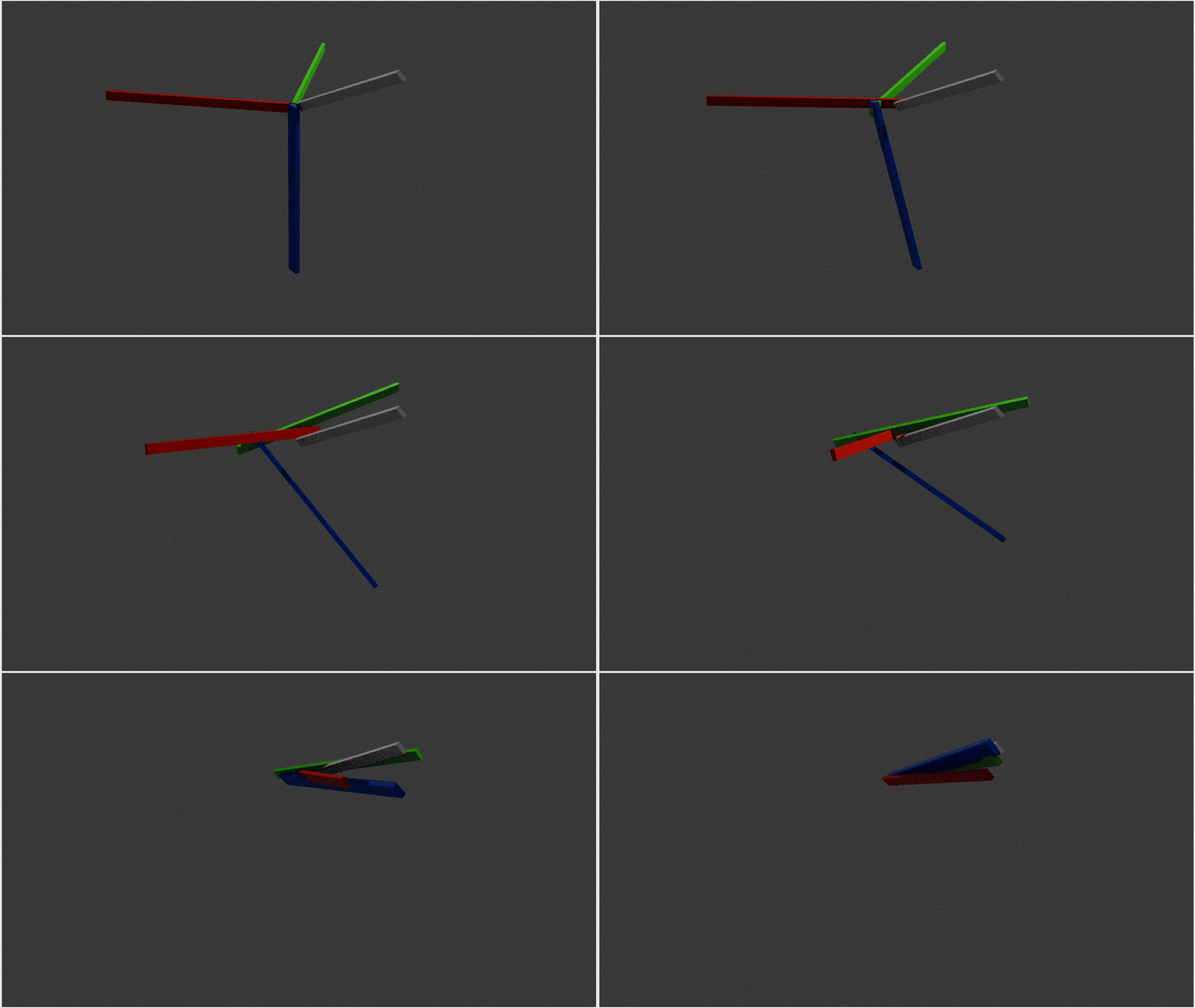
Maybe the 4D is a deformation of all axis in one time :shock:

That is my gif is here

Image

All axis space are flatten in one time :shock:

What do you think of that my theory ? :mrgreen:
threedslider
Enthusiast
Enthusiast
Posts: 562
Joined: Sat Feb 12, 2022 7:15 pm

Re: What 4D looks like ?

Post by threedslider »

Why all axis are flatten in one time is comparable to the light in prism where is splitting all colors :shock:
Post Reply